


Electrostatic discharge (ESD) control test in accordance with the policy established in the ANSI/ESD STM12.1-2019 standard, applied to two models of ESD ergonomic chairs.
The objective is to compare the performance of two configurations:
- Chair with chrome bar.
- Chair with painted bar.
Applying the following test points:
- ESD S4.1: Protection of items susceptible to electrostatic discharge – Work surfaces – Resistance characterization.
- ESD STM4.2: Protection of items susceptible to electrostatic discharge – Work surfaces – Charge dissipation characteristics.
SCOPE AND APPROACH
The tests were applied to two ergonomic chairs with conductive upholstery and metal bases, in compliance with standards ESD S4.1 and ESD STM4.2, focusing on contact points and discharge paths between the backrest, seat, and ground point.TOOLS USED
To perform accurate measurements, we utilized the DESCO LCD MEGOHMMETER – Item A50070.
This tool allows us to measure surface resistance and ensure compliance with the recommended limit of < 1 × 10⁹ ohms for ESD protected areas.
Note: The ESD STM4.2 test was applied at 100 volts.
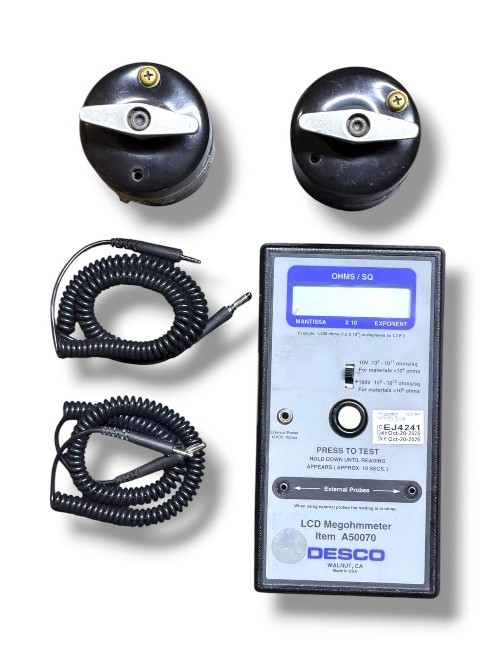
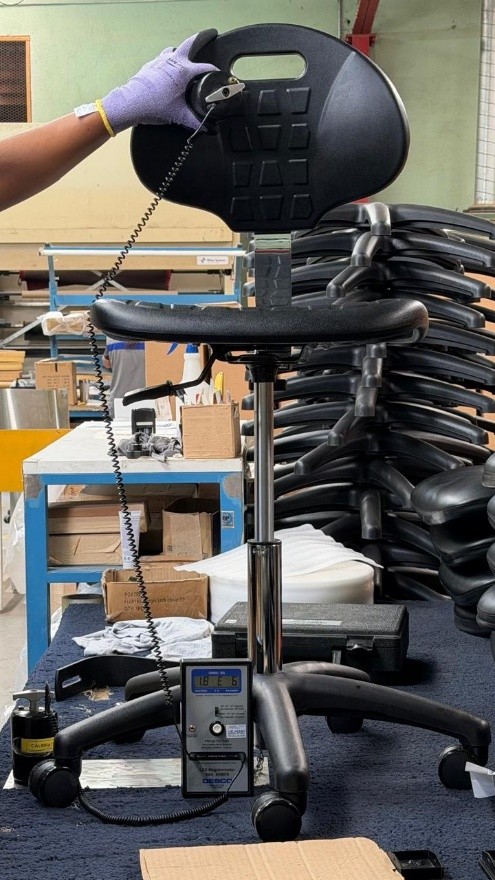
PROCESS & RESULTS for Backrest
The tool was placed at Backrest on each chair. Both models performed well within the safe range.
| Test Point | Chromed Bar (Ω) | Painted Bar (Ω) | Limit |
|---|---|---|---|
| Backrest | 1.8 × 10⁶ | 1.4 × 10⁶ | < 1×10⁹ |

PROCESS & RESULTS for Seat
The tool was placed at Seat on each chair. Both models performed well within the safe range.
| Test Point | Chromed Bar (Ω) | Painted Bar (Ω) | Limit |
|---|---|---|---|
| Seat | 3.2 × 10⁶ | 3.3 × 10⁶ | < 1×10⁹ |
PROCESS & RESULTS for J-Bar
The tool was placed at J-Bar on each chair. Both models performed well within the safe range.
| Test Point | Chromed Bar (Ω) | Painted Bar (Ω) | Limit |
|---|---|---|---|
| J-Bar | 7.8 × 10⁶ | 1.2 × 10⁶ | < 1×10⁹ |
Observations:
- For standards that include multiple resistance test methods, these limits apply to all methods.
- The ANSI/ESD STM4.2 tests were applied at 100 volts.
CONCLUSION
Both chairs comply with the resistance limits established by standards ANSI/ESD STM12.1-2019, ESD S4.1 y ESD STM4.2.
The difference in the bar finish (chromed or painted) does not significantly affect electrostatic behavior or charge dissipation.
Therefore, both models are suitable for use in ESD work areas, maintaining resistance within the safe range (< 1×10⁹ Ω) and stable dissipative behavior.